James Ron - Shame: A Letter to my Children
Updated: Sep 6, 2025

My children,
I am ashamed and feel the need to explain why.
When I was your age, back in the mid-1980s, I volunteered for a demanding unit in the Israeli military, a specialized part of the country's storied Parachute Brigade. The men I served with were the structural equivalent of Brahmans in Israel's military-informed caste system.
I was immensely proud of my service. The unit was difficult to join and survive, and success did not come naturally. My family had no distinguished military past, and I was not prepared for the huge physical and mental challenges required.
I was also a new immigrant, having arrived in Israel only nine years earlier. It had taken me three years to learn Hebrew, and I was desperate to belong. In that country, at that time, excellence in combat training seemed like the surest path to social acceptance, so I embraced the journey with every fiber of my being.
I completed my three years of mandatory service in early 1988, and then volunteered once again for a reserve unit tasked with training for even more demanding missions.
I continued to be immensely proud of my service.
In all those years, I encountered unarmed civilians only three times, all in Lebanon. I am not proud of those encounters, but they were limited. No one died.
Because of the nature of my reserve duties, I was spared engagement with the first Palestinian uprising, which began in late 1987 and continued for several more years. I did not participate in Israel's brutal repression of that event, a shameful episode eloquently described, among others, by Zeev Schiff and Ehud Ya'ari, two of Israel's leading journalists. Right after the 1991 Gulf War, following preparations for an aborted mission to hunt Scud missiles in Saddam Hussein's Iraq, I refused to train any more in the Palestinian territories. I didn't want to participate in the occupation, even though our unit only used the West Bank to prepare for missions elsewhere.
In response, the military buried my file in a bureaucratic black hole, and I never wore a uniform again. And yet, I remained proud of my service.
In the 1990s, I did investigative work in the Palestinian territories for Human Rights Watch, and began to suspect something was badly amiss. Our country's disregard for Palestinian well-being was making me increasingly uncomfortable, although I still only dimly grasped the outlines of the problem. In 2003, after studying at Stanford and Berkeley, I published a book attempting to specify the conditions under which Israel might engage in ethnic cleansing.
Frontiers and Ghettos used social science theory and historical comparisons to speculate on the conditions under which the unthinkable might occur. I searched for a hypothetical trigger that might tempt Israel to engage in the most awful forms of violence against Palestinians.
Today, my worst fears have come to pass. Israeli forces have engaged in some of the most dramatic forms of violence against Palestinians imaginable, and this is where the shame really begins.
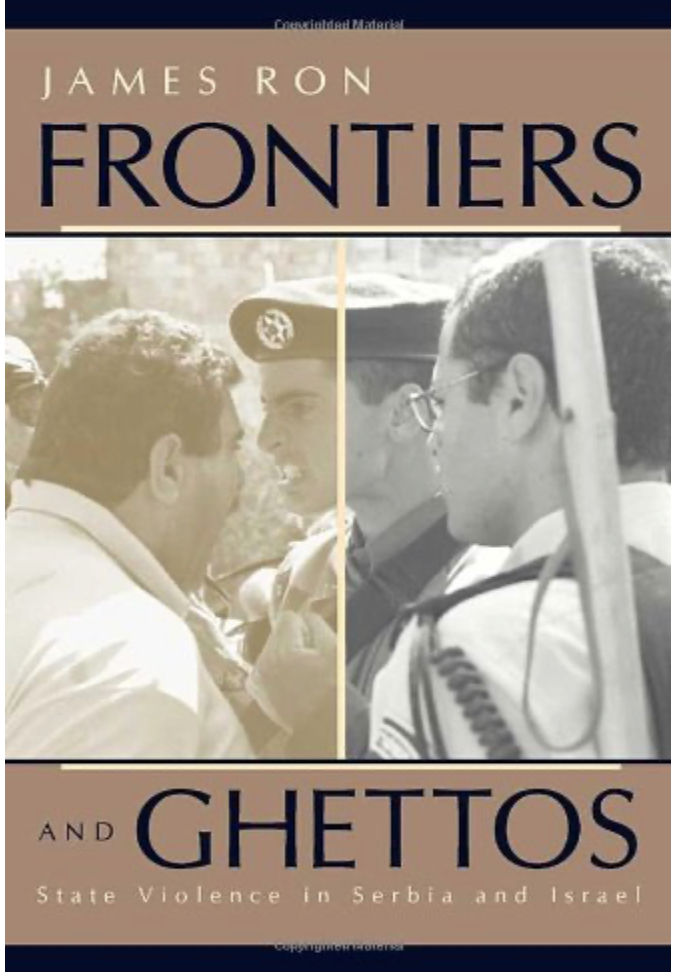
Although the book's basic prediction was correct, it did not get everything right. For example, I misidentified the context and probable trigger for intense Israeli state coercion.
The book had hypothesized that an international attempt to force Israel to withdraw from the West Bank would encourage right-wing settlers to initiate a wave of ethnic cleansing, likely with clandestine government support.
Things did not unfold that way, however. Instead, Israel's right wing took over the government wholesale in democratic elections, obviating the need for backroom dealings.
And in the end, the immediate trigger for the onslaught was not international recognition of Palestine's sovereignty, as I had expected, but rather Hamas's vicious attack on October 7, 2023, along with its violent seizure of hundreds of Israeli hostages.
Once all that occurred, however, things evolved more or less as I feared. The Israeli military was transformed into an instrument of horrific suffering, engaging in activities that violate almost every clause of the Geneva Conventions.
In the first weeks and months after the Hamas attack, some of Israel's military operations may have been justifiable under the laws of war. Even the most damaging air or artillery strikes can be legal if they are proportionate and discriminate, and if reasonable precautions are taken to protect civilian life. This is the unfortunate truth embedded in the laws of war: during armed conflict, not everything terrible is illegal.
Many of Israel's actions in Gaza are war crimes, as documented by Hebrew University historian Lee Mordechai, among others. Several Israeli leaders, including a former prime minister, have openly acknowledged this fact.
Many non-Israeli sources - Palestinian journalists, international NGOs, and others - have documented Israel's Gaza crimes in chilling detail, including two stalwarts of the modern human rights movement, Human Rights Watch and Amnesty.
For Israelis skeptical of foreign observers, there are plenty of local sources to draw from. In addition to Lee Mordechai's work, we have reports by B'Tselem and its partner, Physicians for Human Rights-Israel, along with reporting from the Israeli daily, Ha'aretz.
To date, much of the debate has centered on the question of genocide: what it is, precisely, and whether Israel's actions have crossed the requisite legal threshold.
For me, that debate is not crucial. Few serious observers disagree that Israeli forces are causing enormous suffering for Gazans, and most agree that at least some of that involves crimes of war. It's hard to argue otherwise, even if you are sympathetic to Israel's concerns.
To be sure, not every Israeli soldier has committed war crimes. Far from it. And I'm sure that many of the people involved do so because they feel it is the right thing.
Some of the men in my former Parachute Brigade unit have volunteered for the reserves at an advanced age. They want to help their country. The Hamas attack made Israelis feel exceedingly unsafe, and these men want to restore security to their towns and families. Few, if any, will serve in Gaza, but if they did, they would conduct themselves honorably. Many others in the military, including younger reservists and ordinary soldiers performing obligatory service, want to do the right thing. The children of friends are now serving in Gaza. If their parents have had any influence on them, these youngsters will not directly engage in atrocities.
Instead, responsibility for much of the military's criminal behavior in Gaza lies with its senior commanders and political leadership, not with low-ranking soldiers or middle-tier officers.
But this, to me, is clear: In Gaza, the Israeli military as a whole has collectively engaged in a crime of immense proportions. Anyone who is part of that system, no matter how individually honorable, cannot avoid being pushed, prodded, and pulled into that fundamentally criminal endeavor, regardless of their personal intentions.
War crimes should be investigated and judged on a case-by-case basis, but collective moral responsibility is a different beast. And this is where the shame begins in earnest.
After being bombed, machine-gunned, displaced, deprived of medical treatment, denied clean water, and tortured, two million Gazans are now being starved by the very same military I served so proudly years ago.
We have only incomplete data on how many Palestinians have died to date, as many Gazans remain buried under the rubble. Many others will die slow and painful deaths in the months to come because they were repeatedly displaced, forced to sleep in the open, prevented from obtaining medical treatment, or deprived of access to adequate sanitation, water, and food.
Older people, people with chronic diseases, young children, and other vulnerable individuals will be particularly at risk. I shudder to think of senior citizens like my 84-year-old mother forced to sleep in the open under conditions of acute deprivation. Or to imagine young people like my son, who has type 1 diabetes, searching in the rubble for syringes and insulin.
At this moment, the starvation unfolding in the Strip is my greatest shame. Nothing, but nothing, can justify intentional starvation. Even in war, this is an unambiguous crime. You can always claim that this or that airstrike was warranted because it targeted a Hamas military position, but the denial of food to an entire population is never justified.
Some claim Israel allows sufficient aid to enter the Strip, only to have that food systematically stolen by Hamas. Both Israeli and US official sources, however, dispute this claim. And even if true, Israel should respond by flooding the Strip with foodstuffs to eliminate incentives to steal.
My children, this is not your war, and it is not your responsibility. Your mother and I made sure you were not born into that conflict, and have raised you far away, in a place comparatively free of terrorism, ethnic violence, conscription, and repression. Unlike you, I am still tied to that world through history, friendship, and inherited responsibility. Much of that responsibility stems from my decision forty years ago to enthusiastically pursue combat-oriented service, and from the pride I took in those activities.
I wanted so desperately to belong, and for a time, I succeeded. That sense of belonging, however, has come at a terrible price. It implies moral responsibility, and now, I am both implicated and thoroughly ashamed at what has happened over the past months. My fellow Israelis, what have we done? What have we become? How can anything justify these actions?
We may not see it now, immersed as we are in our own pain and information ecosystem, where the only things that matter are the well-being of our soldiers, families, and hostages.
That immersion, however, is a self-defeating bubble. Eventually, we will be forced to recognize the full horror of what we have done to Palestinian Gazans. And when that happens, the stench of our collective shame may prove impossible to wash off.
--------------
A shorter version of this letter appeared on the University of California Press blog, A Sad Prediction Born Out By Events. To learn how the Gaza war was anticipated by James Ron's 2003 book with the University of California Press, Frontiers and Ghettos: State Violence in Serbia and Israel, check out his social science research blog.
About James Ron
James Ron is an author and social scientist whose career has spanned military service, human rights investigations, journalism, and university teaching. He is working on a memoir, Azimuth, which reflects on a life lived at the intersection of political violence, moral responsibility, exile, and personal transformation.
Learn more at www.jamesron.com | www.jamesron.org | www.jamesron.net
Connect: LinkedIn | ResearchGate | Google Scholar


Comments